
What is human intelligence?
The conceptual foundation: what human intelligence consists of when machines take over more and more cognitive work.

HUMAN INTELLIGENCE
Human intelligence describes what makes people more than knowledge and computing power: judgement, empathy, creativity and the willingness to bear responsibility. AI writes, programs and analyses better and better. That makes the question of what we humans need to learn more important. This is about exactly that question.
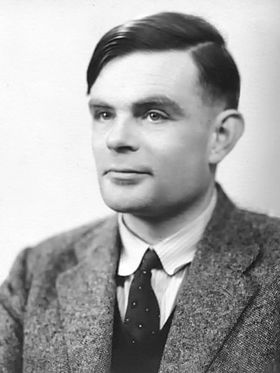
London / “Can machines think?”
Alan Turing
„Alan Turing (1951)“ by Elliott & Fry, 1951
Source: Wikimedia Commons / Computer History Museum · Licence: Public domain (UK: photograph published before 1956, term of protection expired) · Image credits
In 1950, Alan Turing asked a question that he himself already considered problematic: “Can machines think?” In his paper “Computing Machinery and Intelligence” he therefore replaced it with another one – whether a machine can be told apart from a human in conversation. Not whether machines think, but whether we would notice. More than seventy years later, this shift is more topical than ever. The question is no longer whether AI can answer us in a deceptively similar way. But what is actually left once it can.
We can’t save ourselves with our abilities.
For a long time it was comfortable. Computers could calculate. People could think. Then computers could play chess and people were creative. Then came the images. The texts. The music. The programming.
In 2026, leading AI models now reach or exceed human benchmarks in various tests of mathematics, scientific knowledge and multimodal reasoning.
At the same time, the same systems partly fail at tasks that seem downright ridiculously easy to a human. Stanford aptly calls this “jagged intelligence”.
Perhaps we should therefore stop trying to separate humans from machines by a list of abilities. That list isn’t getting longer, after all, but shorter.
Calculating, writing, seeing, programming, reasoning: in all of these, machines have come very far. What doesn’t automatically grow with them is responsibility.
AI probably won’t take our work away. That would at least be clear.
Reality is likely to be more complicated. The International Labour Organization examined almost 30,000 tasks. Its finding: around one in four employed people worldwide works in a job that can be at least partly affected by generative AI. But only 3.3 percent of global employment is in the highest exposure class.
The ILO therefore doesn’t consider complete replacement of jobs the most likely scenario. Jobs change. And that is possibly the bigger challenge.
Because then we don’t have to learn to live without work. We have to learn to work differently.
Sources: Stanford AI Index 2026 · ILO – Generative AI and Jobs, 2025
1 in 4
One in four employed people works in a job with at least partial GenAI exposure. Exposure does not mean job loss.
Interestingly, companies respond to more AI not only with more technology.
In the Future of Jobs Report 2025, employers name analytical thinking, resilience and flexibility, leadership and social influence, and creative thinking, among others, as important skills. Empathy and active listening are named as core skills by 50 percent.
Of course we need AI skills. But apparently we also need a great deal of what we would once simply have called being human.
For a very long time we measured intelligence by things that are easy to test. Calculating. Remembering. Recognising patterns. Solving problems. Of all things, machines are getting frighteningly good at exactly these.
That could mean machines are becoming more and more human. But it could also mean our definition of intelligence was rather mechanical.
A human, after all, doesn’t consist only of the ability to produce a correct answer. We make mistakes. We change our minds. We love people, although sometimes there are downright poor rational grounds for it. We take responsibility. We act against our own advantage. We invent things nobody needs. And sometimes we just sit by the sea and do nothing at all. Try mapping that in a benchmark.
AI can decide. But is it allowed to?
This is the point where technical intelligence and human responsibility come apart. An AI can assess job applications, support diagnoses, estimate credit risks, write texts and prepare decisions.
But from the fact that something is technically possible it does not follow that we should do it. And certainly not that nobody is responsible any more.
The more capable AI becomes, the more important a thoroughly human activity becomes: saying no. Or yes. But then please with a reason.
We’re not particularly interested in technology without people.
Further reading
Stanford AI Index · ILO Future of Work · WEF Future of Jobs · OECD AI
The conceptual foundation: what human intelligence consists of when machines take over more and more cognitive work.
What state power, democratic responsibility and ministerial reality would make of AI.
How work, education, justice and the way we live together change when AI becomes normal.
That is exactly what we talk about in our workshops, not about the perfect prompt. It is about what AI does to work, decisions, responsibility and your own role. And of course about how you use it. Ignoring it probably won’t work.