
Two individual sessions per month
30 minutes each, via Teams or Zoom. For one person, but with their role, their questions and the team that depends on their decisions in view.

Services
A workshop can be a good start. The real problem often begins afterwards. New models appear, questions come up in daily work, first attempts lead nowhere, and somewhere between enthusiasm and overload AI becomes a topic for later again. That is exactly what our AI coaching is for. Not as a group format for whole departments, but as individual support for single people who make decisions, are responsible for topics or have a team behind them.
California / Knowledge, responsibility, decision
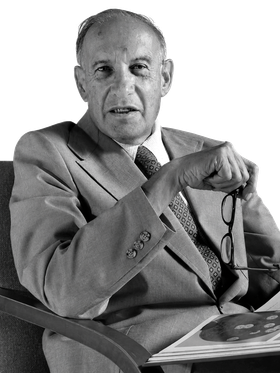
Peter F. Drucker
„Drucker5789“ by Jeff McNeill, 2011
Source: Wikimedia Commons · Licence: CC BY-SA 2.0 · Image credits
Editing: Changes: cut out (background removed), cropped, scaled. The edited version is under the same licence, CC BY-SA 2.0. Edited by Today is Life.
With new technologies, Peter Drucker cared less about what they can do technically. He cared about what they do to companies and to work. Long before AI, he described the shift from physical and routine work to knowledge work. People would increasingly be paid not for carrying out instructions, but for applying knowledge, making decisions and taking responsibility. With AI, that line shifts again. Knowledge alone gets cheaper. What matters is which questions we ask and what we do with the answers. Technology changes work. People decide what comes of it.
Many companies now take AI seriously. But putting it into daily practice often stays surprisingly thin. After a workshop the possibilities are clearer, but then the questions that really matter come up in the day-to-day. Which tool is actually good for which task? How does a process change when you don’t just decorate it with AI but rethink it? What is just hype right now, and what has substance? And which of it fits your own organisation at all?
That is where continuous coaching helps more than another one-off session. And one person at a time: exactly the person who is meant to push a topic forward, make decisions or bring a team along. Inside a company, AI rarely becomes effective because twenty people heard roughly the same thing. It becomes effective when individuals start using it more cleverly in their own area of responsibility and pass on what they have learned to the team.
Our AI coaching is therefore not a motivation programme and not outsourced trend-watching. It is a deliberately small but regular format for one person. Tailored to their needs, but always with an eye on the team and the context behind them.
30 minutes each, via Teams or Zoom. For one person, but with their role, their questions and the team that depends on their decisions in view.
Not every new model version matters. We filter what actually makes a difference for your work and your environment, and what you can safely ignore.
Between sessions, questions don’t have to wait. You send us your points, and we help you put things in context, set a direction and plan next steps.
After every session we note the key points, decisions and next steps briefly, so that nothing disappears into the meeting fog.
The biggest gain is usually commitment, not a spectacular single idea. People try more when they know there is another appointment in two weeks where experiences, questions and dead ends get discussed. Casual testing gradually turns into a better way of working.
Then there is a second thing: speed without panic. Many companies currently experience AI as both an opportunity and a burden. Everything moves fast, but nobody has time to read product announcements every day or to test every new tool. In coaching we take on exactly that part, the sorting and putting in context. This is not a trend briefing, but context tailored to your requirements. What helps you concretely? What is relevant in your role? What is worth doing now? And what rather not yet?
And finally, the format creates something that is often missing in the AI discussion: calm. By that we mean clarity, not slowness. Instead of hurriedly bolting a little AI onto everything, you work in a more focused way. With real questions. With concrete processes. And with an outside view that neither celebrates every new tool nor reflexively fends off everything with scepticism.
Coaching makes most sense for individuals who have already had first contact with AI and don’t want to start from zero again now. Managers, marketing leads, heads of department, product people or internal drivers of such topics often benefit most. They don’t have to solve everything alone, but afterwards they take the points into their team, their processes and their decisions.
One thing matters here: we coach per person, not per whole department. That keeps the format focused and concrete. We look after at most ten people at a time, so it stays individual and doesn’t slide back into a generic group session.
Sometimes it starts with better prompts, sometimes with a clearer choice of tools, sometimes with the realisation that a process would have to be thought through quite differently. And sometimes with the reassuring insight that you shouldn’t do something just yet. That is progress too.
Monthly
Continuous support for one person with two individual 30-minute sessions per month, email support and a short follow-up.
Then less hype and more regular, concrete support often helps. Together we look at what your team really needs and whether the coaching format fits.